

What to put on the About page of a heating engineer website
Most heating engineer About pages are a stock photo and a paragraph that says 'pride ourselves on quality'. Here's what to put on yours that actually earns trust, plus a template that works for a single-engineer business.
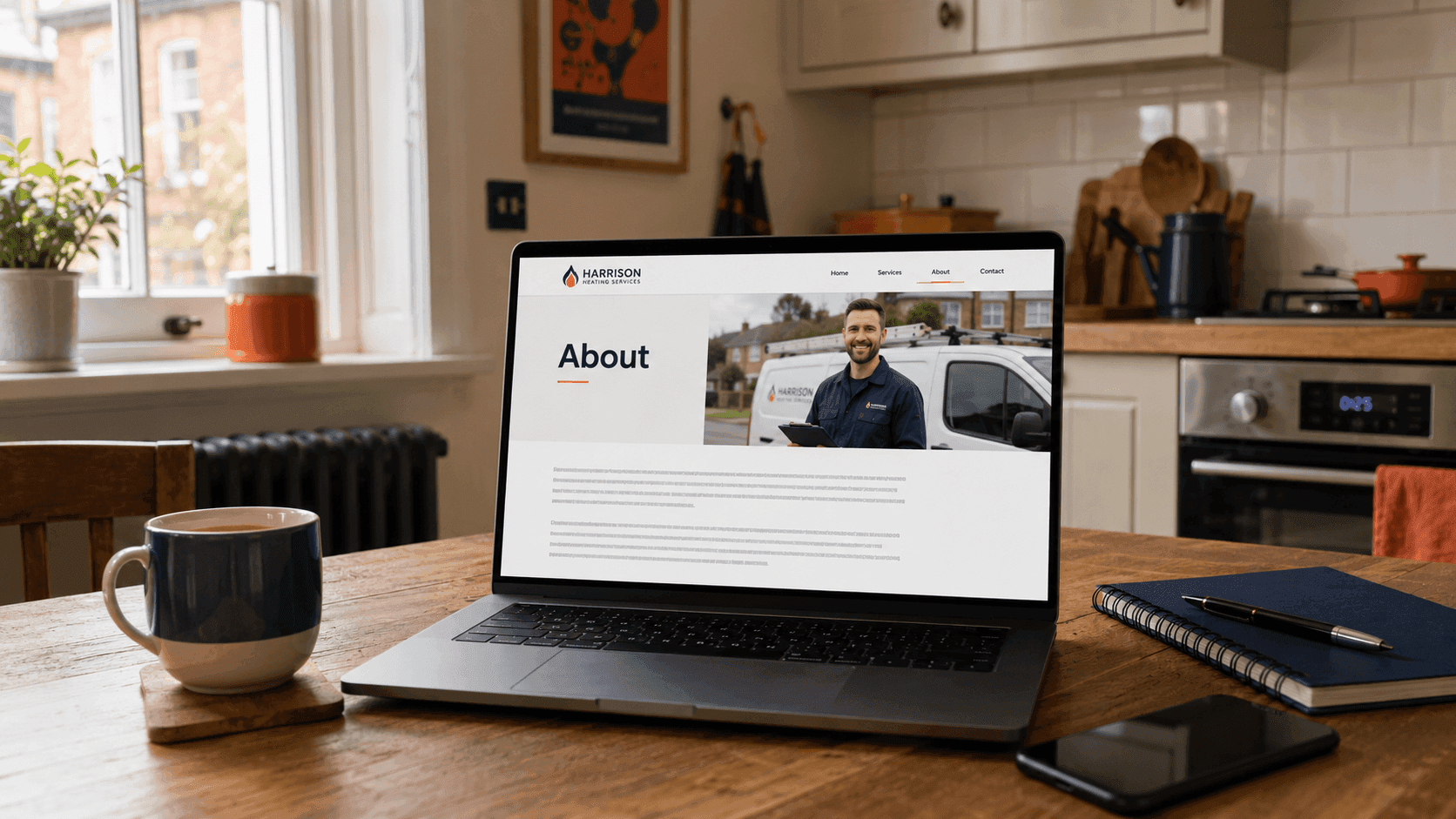
The answer in one line: the About page needs a real photo of you, a clear Gas Safe number, the genuine number of years you've been doing the work, the brands you're accredited for and one short paragraph about what you actually do day to day. No stock photos, no "pride ourselves on quality" and no buzzwords.
Most heating engineer About pages look the same. Stock photo of a wrench. One paragraph that opens with "Welcome to our website" and ends with "for all your heating needs". A Gas Safe logo. Done.
The page is doing 5% of the job it could be doing. In our experience the About page is one of the highest-converting pages on a heating engineer's site, second only to the service pages. It's where the homeowner who's already half-decided checks whether to actually pick up the phone. This post lays out what to put on yours, what to take off and a template that works for a single-engineer business.
Why does the About page matter more than most engineers think?
Homeowners aren't booking a heating engineer the way they book a takeaway. The job involves them letting a stranger into their home, sometimes for a full day, sometimes with mess and noise, and trusting that stranger to charge them a fair price.
The About page is where that trust gets earned or lost. Three reasons it carries more weight than the rest of the site.
Buyers in the final mile. Most visits to a heating engineer site bounce off the home page or land on a service page and bail. The visits to the About page are people who've already half-decided, want to know who you actually are and then call. Higher-intent traffic. Higher conversion if the page does its job.
Trust isn't on the home page. The home page is selling. The service pages are explaining. The About page is the only one where the question "would I let this person in my house" can be answered straight.
Local SEO carry. Google reads the About page for signals about the business: location, owner name, years in business, accreditations. A specific About page helps you rank for "[your name] heating engineer" searches and for brand-trust signals in the local pack.
What are the 5 things every heating engineer About page must have?
The non-negotiables, in order of impact.
1. A real photo of you. Not a stock image, not a logo, not a photo of a boiler. Your actual face, ideally in work clothes, ideally on a real job. Customers want to see who's coming round. The single biggest lift you can make to your About page is replacing a stock image with a real photo of you in your van or holding a clipboard in someone's airing cupboard.
2. Your Gas Safe register number, clickable. Your Gas Safe number, linked to the Gas Safe register check page (https://www.gassaferegister.co.uk/find-an-engineer-or-check-the-register/) so the customer can verify in one click. Don't just slap the logo on. The link to verify is what earns trust. If you only work on oil, list your OFTEC registration. If only electric, say so clearly.
3. The genuine number of years you've been doing this. Round numbers, honestly stated. "12 years on the tools, 8 of those as a sole trader" is more credible than "experienced heating engineer". If you're new, frame the time honestly with what came before: "Qualified Gas Safe in 2024 after 7 years as a commercial plumber".
4. The brands you're accredited for. Vaillant Advance, Worcester Accredited Installer, Ideal Heat Pump Specialist, MCS for heat pumps. List the real ones with the proper current names. Don't list anything you can't substantiate. This is also where you say what brands you prefer working with and why, if that's true.
5. One paragraph about what you actually do day to day. Not "specialising in all aspects of heating". Genuine: "Most of my work is gas boiler installations and services, with a growing share of heat pumps. About 70% of jobs come from word of mouth in [town] and surrounding villages. I cover a 15-mile radius and don't take on jobs outside that."
Five elements, properly done, beats every "pride ourselves on quality" About page in your town.
The photo question: why a stock image kills the page
This is worth its own short section because it's the single biggest mistake we see.
A stock photo of a smiling man with a wrench is recognisable as a stock photo to anyone under 60. The moment a customer spots a stock image, the rest of the page reads as marketing-speak, even if the words are honest.
A phone photo of you, in work clothes, in front of your van or holding a manifold, looks less polished and earns more trust. Three options if you don't have one:
Get a mate to take one this week. 5 minutes, decent natural light, you in work clothes, hold a tool, look at the camera. You don't need a photographer.
Ask your next customer if you can use a photo from the job. Most are happy, especially if the job went well. Get one with the boiler or the radiator behind you and your hands working.
Pay £50 for a local photographer for half an hour. Two or three usable shots is all you need. Cheaper than the cost of a single lost customer.
The bar is "this looks like a real human who came to fix my mum's boiler". It isn't a glamour shot.
How do you write about years of experience honestly?
The most common mistake is the inflation pattern: "experienced heating engineer", "many years on the tools", "established business". Vague years are read as either old (boring) or hiding something.
Three honest patterns that work.
Specific numbers. "12 years on the tools, 8 of those running my own business." Specifics signal confidence.
The honest new-engineer story. "Gas Safe qualified in 2024 after 6 years in commercial plumbing. I started taking on domestic work this year." Reads as authentic. Customers who care will hire you anyway. Customers who only want 20-year veterans wouldn't have hired you regardless.
The genuine career path. "Started as an apprentice with my dad in 1998. Took the business over in 2015 when he retired." If the family-business story is true, use it. Don't invent one.
What doesn't work: "Bringing decades of expertise". Decades is vague. Expertise is unspecific. Both read as marketing.
What about accreditations? Which ones actually matter?
In order of weight to a UK homeowner deciding on a heating engineer:
- Gas Safe register number (mandatory for gas work, no exceptions)
- Manufacturer accreditations (Vaillant Advance Installer, Worcester Accredited Installer, Ideal Installer, Baxi Approved Installer)
- MCS if you do renewable installations (heat pumps, solar thermal)
- OFTEC if you do oil
- Trade body memberships (CIPHE, BESA, APHC) — nice to have, less weight
A few rules of thumb.
- List the ones you genuinely hold. Don't list ones you're "working towards".
- Use the proper current names ("Vaillant Advance Installer" not "Vaillant approved", "Baxi Approved Installer" not "Baxi G3" — G3 is a separate Building Regulations competence for unvented hot water).
- Where possible, include the proper logo (manufacturers usually have a media-pack page where you can download an approved logo).
- One sentence on why a given accreditation matters to the customer: "Vaillant Advance Installer means the boiler comes with the 10-year warranty extended" is more useful than just the badge.
What NOT to put on the About page (the bin list)
The patterns that pull the page down.
- "Welcome to our website" as the opening line. Reads dated.
- "Pride ourselves on quality" and variants. Marketing-speak. Customers tune out.
- A list of every service you do. That belongs on the services pages, not the About page.
- Generic shots of plumbing tools. See the photo section above.
- Awards or quotes the customer can't verify. "Best heating engineer in [town] 2019" with no source.
- A 1,500-word company history. 200 to 400 words is plenty. Customers skim. Length signals nothing positive.
- A "we" when it's just you. "We're a family-run business" when it's one bloke and a mate is fine. "We" suggesting a team when it's one person reads as inflated.
The page should read like the engineer is talking to a customer at a kitchen table, not pitching investors.
A template that works for a single-engineer business
A working About page structure for most one or two-engineer businesses. Adapt the words. Keep the order.
About [your business name]
[Real photo of you, ideally with your van or in work clothes]
I'm [first name], the engineer behind [business name]. I've been on the tools for [X] years and running [business name] for [Y] of those, covering [town] and the surrounding [radius/area].
What I do Most of my work is [main service 1], [main service 2] and [main service 3]. I also cover [secondary services]. I don't do [services you don't cover], so if you need those I can usually point you to someone reliable.
Accreditations
- Gas Safe Register: [your number] — [link to verify on the Gas Safe register]
- [Manufacturer 1] Approved Installer
- [Manufacturer 2] Accredited
- [Other genuine accreditations]
How I work I quote in writing before any job over £[threshold]. I cover [warranty terms]. I don't pressure-sell. If a boiler isn't the right answer I'll say so.
[Optional: one paragraph on why you got into the trade or what's different about how you work, only if it's true and specific]
If you're in [coverage area] and looking for someone, [link to contact page].
Three to four short blocks. Honest. Specific. No buzzwords.
A note on reviews on the About page
If you have 10+ Google reviews (here's how to get there), put a row of the best three on the About page near the top. Real customer name (first name + last initial), the actual review text, a star rating. Three reviews on the About page lift conversion more than another paragraph of copy.
Don't make up reviews. Don't paraphrase reviews to sound better. If you don't have any yet, leave the section out and add it when you do.
Where to start
Three concrete moves this week.
- Get a real photo of yourself this weekend. 5 minutes with a phone, in work clothes, decent light.
- Write 200 words about what you actually do. Talk it out into a voice note if writing is the blocker. Get someone to transcribe.
- List your real accreditations and link your Gas Safe number to the register. 10 minutes of work, biggest single trust signal you can add.
Apply those three and your About page will outperform most local competitor sites without changing anything else.
The £295 Syntorak heating engineer website includes the About page written from your inputs, with your real photo, your real accreditations and your real coverage area. Read why the 10-page spec matters or how to get the first 10 Google reviews you'll put on this page.
The About page is the one your customers look at last and decide on. Make it the one a real human wrote.
FAQ
Common questions about this
Should I include my age or how many years I've been doing this?
I'm new — won't 'started last year' hurt me?
What if I don't have a Gas Safe certificate yet?
Should I mention apprentices, family members or other engineers I work with?
Can I use ChatGPT to write my About page?
Related
More for heating engineers
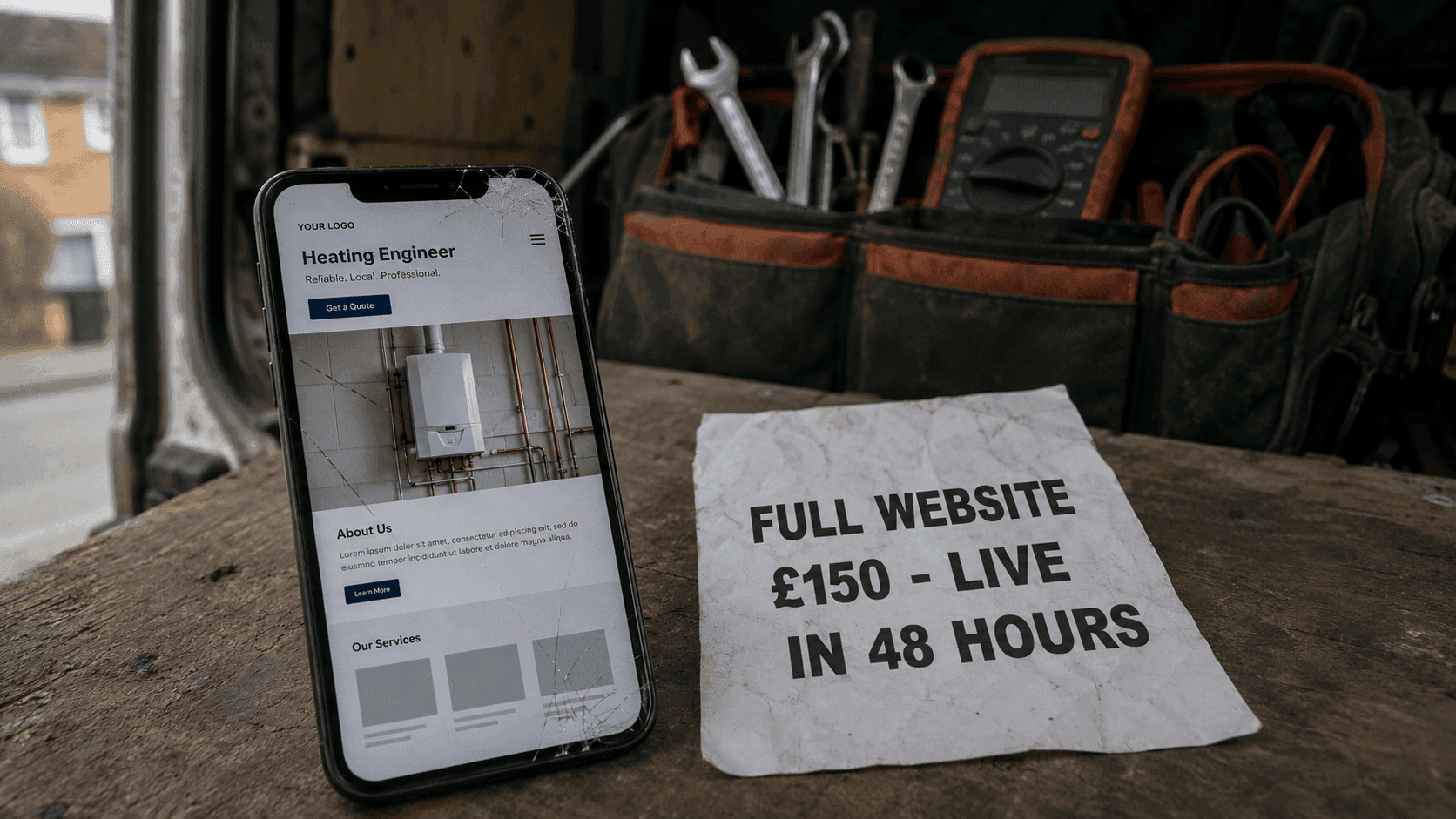
The £150 cheap-builder website trap for tradespeople
There's a tier of websites pitched at tradespeople at £150 to £250 a build. Most are generic WordPress installs with no SEO, no proper hosting and a builder who disappears within 3 months. Here's how to spot the trap before you pay and what to do if you've already paid.
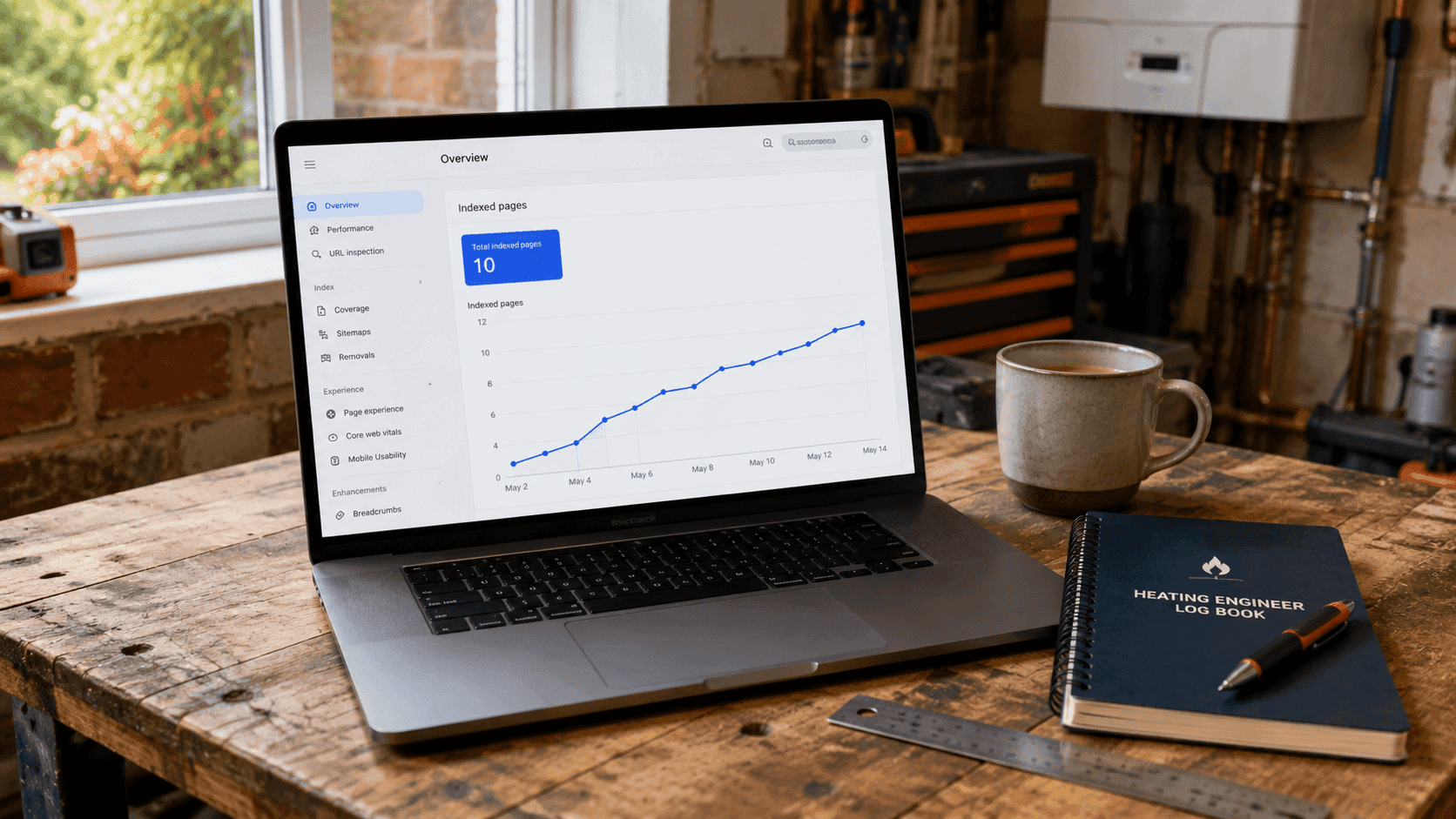
How long does Google take to index a new heating engineer website?
Bought a website weeks ago and still nothing on Google? That's normal in week 1, less normal by week 4. Here's what indexing actually means, how long it really takes and the four things that speed it up.
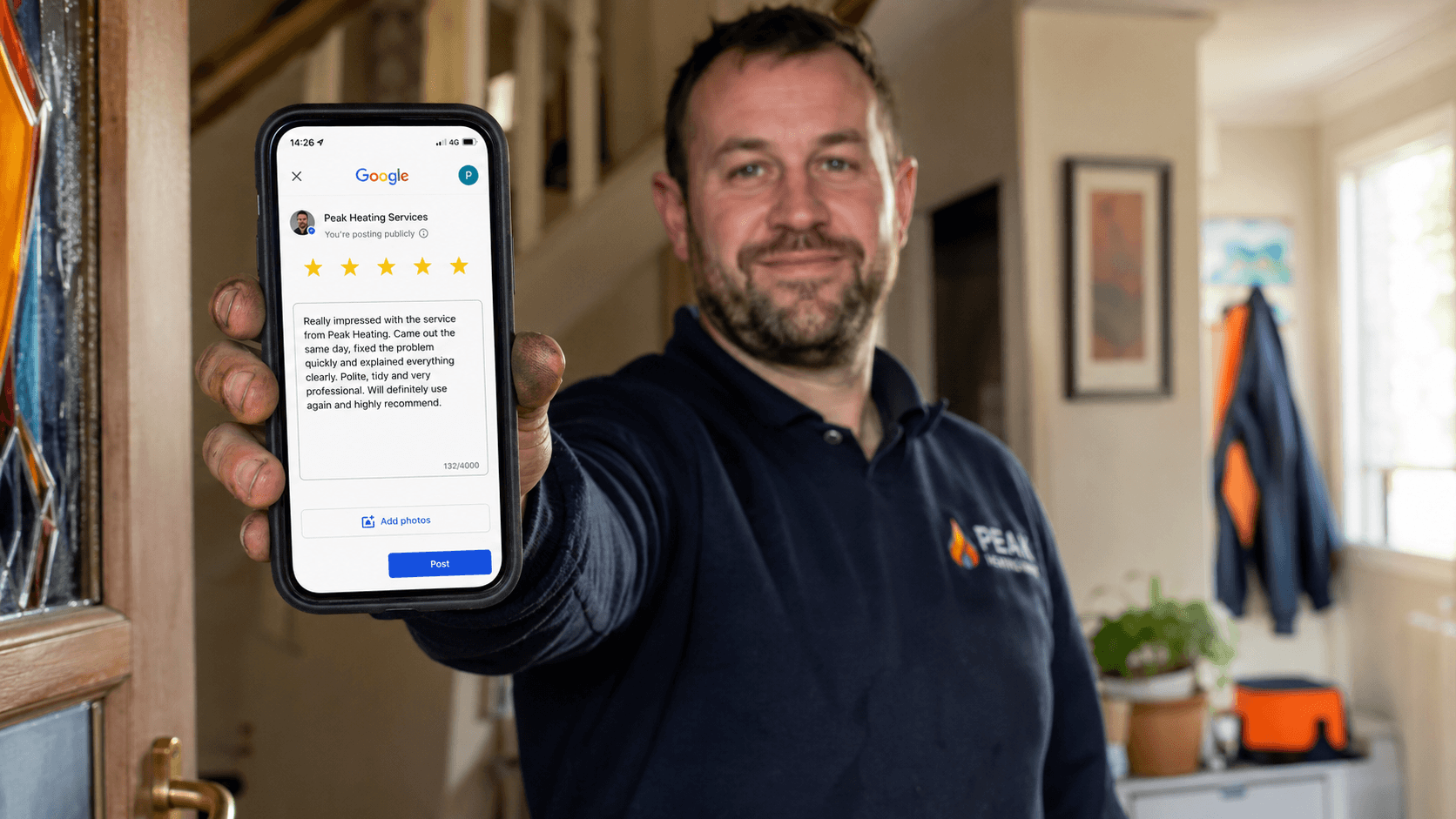
How to get your first 10 Google reviews as a heating engineer
Most heating engineers have 2 Google reviews and don't know how to ask for more. The first 10 are the hardest. Here's the script and the timing that actually work.