

The £150 cheap-builder website trap for tradespeople
There's a tier of websites pitched at tradespeople at £150 to £250 a build. Most are generic WordPress installs with no SEO, no proper hosting and a builder who disappears within 3 months. Here's how to spot the trap before you pay and what to do if you've already paid.
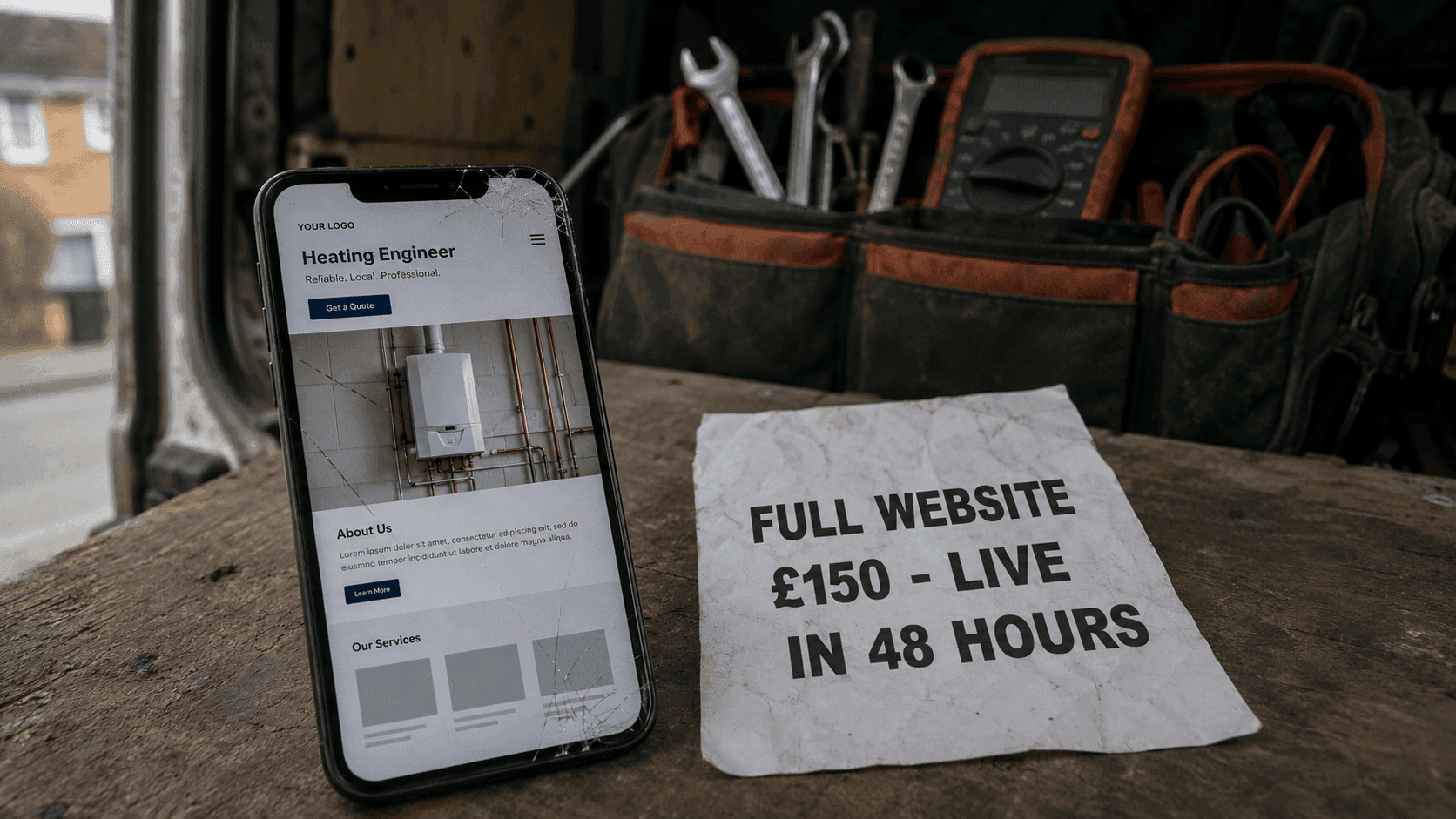
The answer in one line: a £150 website pitched to tradespeople is almost always a generic WordPress install with no SEO, no proper hosting, a domain registered to the builder not you and a "designer" you stop hearing from after 3 months. It's a trap because of the lock-in, not the price.
You'll see the offer in tradesperson Facebook groups, on flyers stuck under your wiper, on Gumtree, on Reddit and on the back of someone else's van. "Full heating engineer website, one-off £150, live in 48 hours, includes domain and hosting."
It sounds like a steal. Sometimes it is. More often it costs you more in lost work and migration headache than buying it properly would have done in the first place. This post lays out what the £150 offer usually is, why it costs more than it looks and how to tell the rare good one from the much-more-common bad one.
What is the "£150 tradesperson website" offer in practice?
The pitch varies. The product almost doesn't.
You pay £150 (sometimes £100, sometimes £250). Within a few days the builder sends you a link to a finished site. It looks fine. There's a homepage with a stock photo of a boiler, a paragraph about your services, your phone number, a contact form and maybe a Facebook link. The domain is something like yourbusinessname.co.uk or sometimes a subdomain on the builder's own platform.
You're happy. Your mates are impressed. Then six months later you check Google, and your business doesn't show up. You try to log into the hosting, the password doesn't work. You email the builder. They reply once, then go quiet. You ask another tradesperson at a job and they say "yeah, mine's like that too".
The £150 wasn't the cost. The cost is everything that happens after.
Why does this offer exist at all?
The economics only work in a few ways.
Side-hustle margin. Someone with a day job spinning up a free WordPress template in 30 minutes per site. £150 minus 30 minutes of work is fine money if you do 4 a week. Quality is exactly what fits into 30 minutes.
Lock-in hosting. The £150 is the loss-leader. The real money is the £15 to £30/month they charge for "hosting" forever, often without telling you upfront. After 2 years of hosting you've paid £600+, which is the price they'd quote for a proper build, but you've got the cheap site.
Offshore at scale. A shop in Pakistan, India or the Philippines doing 10 sites a day at very low cost per site, marketed via UK-based reseller. Quality depends entirely on the spec they were given. Most specs are "make it look like a heating engineer site, use stock images, here are the details".
A genuinely good freelancer learning their craft. Rare but real. A new web designer building a portfolio, charging little because they're new, building good work. These exist. You'll know them within 5 minutes because they ask sensible questions and have a portfolio that proves the work.
The first three are the bulk of the market. The fourth is the unicorn.
The 5 red flags to spot one before you pay
In rough order of how bad each one is.
1. They register the domain in their name, not yours. This is the killer. If you ever want to leave, they can hold your domain hostage. Sometimes they don't even mean to: they registered 30 customer domains under their own GoDaddy account because it was easier. Either way, your business identity is on someone else's account. Insist that the domain is in your name from day one.
2. There's no Google Search Console submission and no sitemap. Without those, your site won't get indexed (see our post on indexing timelines). Most cheap builders skip this step because it takes time per site. The site exists. Google doesn't know.
3. The site is one page. "Full website, one page" is now a common pitch. A single page site cannot rank for the searches that actually bring you customers (here's why you need 10 pages, not 3). It's a digital business card, not a marketing channel.
4. They can't show you three live sites at least a year old that are ranking. Anyone can build a site that looks fine on launch day. Showing you three of their sites that have been live for 12+ months and are pulling search traffic is the only honest proof. If they can't, they probably haven't been doing this long enough or none of their previous work survived.
5. They want full payment upfront before you see anything. Anyone confident in their work shows it to you first. The £295 Syntorak offer doesn't take a penny until you've seen the finished site on a preview link. That's not generosity, it's the standard for anyone who knows their work is worth what they're charging.
If three or more of the above apply, walk away. The site may exist. It won't earn work.
What typically happens at month 6?
A pattern we see often when an engineer comes to us asking for a rebuild.
Month 1. Site looks fine on launch day. You feel good about it.
Month 3. You realise it's never shown up on Google. You ask the builder. They say "SEO takes 6 months" (often true in a sense, but they did none of the basics so it was never going to start). You wait.
Month 6. Still no Google. You search your business name. Maybe Facebook shows up but not the site. You message the builder. Slow reply or no reply. You wonder if they're still in business.
Month 9. You decide to move on. You ask for the domain transfer and the hosting details. Half the time you get them. Other half you don't. Sometimes the original builder has shut down entirely and the site is held in a frozen hosting account no human runs.
Month 12. You're now budgeting for a rebuild. The £150 is gone. Plus 12 months of "hosting" if they charged it. Plus the year of search traffic you didn't get because your site never indexed. Plus whatever it costs to get the domain back if they own it.
This is the honest cost of the £150 trap. It isn't £150. It's £150 plus the cost of a year of invisibility plus rebuilding the right way after.
What you actually get at each tier (honest version)
| Tier | What it usually is | Where it tends to break |
|---|---|---|
| £100-£250 cheap builder | One-page WordPress template, generic copy, no SEO basics, domain often in builder's name | No indexing, no leads, lock-in |
| £150 + £20/mo "hosting" lock-in | Same as above, with monthly fee | Year-2+ cost overtakes a proper one-off build quickly |
| £295 Syntorak | 10 pages, branded video, your .co.uk, Search Console + sitemap submitted, SEO basics done | Designed to earn work, not just exist |
| £800-£2,500 local agency | Often custom design, often good work, often slow and contract-locked | Quality varies wildly, monthly cost £30-£80 after |
| £3,000+ proper agency | Bespoke design, proper SEO from day one | Usually overkill for a small heating business |
The £295 tier exists because the £150 tier doesn't work and the £800+ tier is more than most small heating businesses need.
What to do if you've already bought a cheap-builder site
Three steps, in order.
1. Get the domain in your name. Whoever registered it can usually transfer it for free in 5 minutes. Email the builder, ask politely. If they're decent, it's done that day. If they refuse or go quiet, that's your warning sign.
2. Check whether the site is indexed. Search site:yourdomain.co.uk on Google. If the result count is zero or just one page, the site has the indexing problem and a rebuild won't fix the underlying habits. If the result count is decent (10+ pages), you have something to work with.
3. Decide: patch or rebuild. A patch means submitting the site to Search Console, adding a sitemap and adding 5 to 7 more pages so it has something to rank for. Realistic if the foundation is solid. A rebuild means starting fresh on a proper build (Syntorak £295 or a local agency). Realistic if the existing site has lock-in problems, no real SEO and a builder you can't reach.
The £150 isn't always sunk. If the domain is in your name and the site is real, you can build on top of it. If it isn't, write off the £150 and start clean.
How to spot the rare good cheap builder
They exist. Five quick filters that catch them.
- Three live sites at least 12 months old, each ranking for their main service in their main town
- The domain is registered in your name from day one, no exceptions
- Sitemap, robots.txt, schema.org and Google Search Console all set up as part of the build
- A clear list of what's included and what's optional
- They'll show you a preview link before any payment
A builder who clears all five is almost never £150. They're usually £400 to £900 because they've worked out the time cost properly. Below £400 the unit economics rarely allow for doing the basics right.
The honest summary
Most cheap-builder offers cost more than they look because of three hidden expenses: the year of search traffic you don't get, the migration cost when you eventually rebuild and the time you spend chasing a builder who doesn't reply.
The £295 Syntorak heating engineer offer was built specifically to sit at the price point where the basics actually get done right. 10 pages, your own .co.uk in your name from day one, Google Search Console + sitemap on launch, indexed inside 2 weeks. See the live demo sites, read what the 10 pages are or look at the 5-year cost vs Wix and GoDaddy.
If you've already paid for a cheap-builder site, the first move is checking the domain is in your name. The rest is recoverable from there. Most stories don't end with a writeoff. They end with one painful lesson and a better second site.
FAQ
Common questions about this
I've already paid for one of these. What now?
How can £150 even be possible? Is the person doing it not making money?
What if the cheap builder is local and recommended by another engineer?
Is Fiverr or Upwork the same trap?
What about my mate's son who's doing a web design course?
Related
More for heating engineers

How long does Google take to index a new heating engineer website?
Bought a website weeks ago and still nothing on Google? That's normal in week 1, less normal by week 4. Here's what indexing actually means, how long it really takes and the four things that speed it up.

Wix vs GoDaddy vs custom website for a heating business: the honest 5-year cost
Most heating engineers pick Wix or GoDaddy because it looks cheap on day one. Over 5 years the maths often flips. Here's the honest comparison with real numbers.

Should you have a marketing video on your heating engineer website?
Most heating engineer websites don't have a marketing video. Here's the case for adding one, what should and shouldn't go in it and when it isn't worth the effort.