

10 pages every heating engineer website needs (and why most have only 3)
Most heating engineer websites are 3 pages: Home, About and Contact. They're missing the 7 pages that actually drive enquiries. Here's the full spec and why each one earns its place.
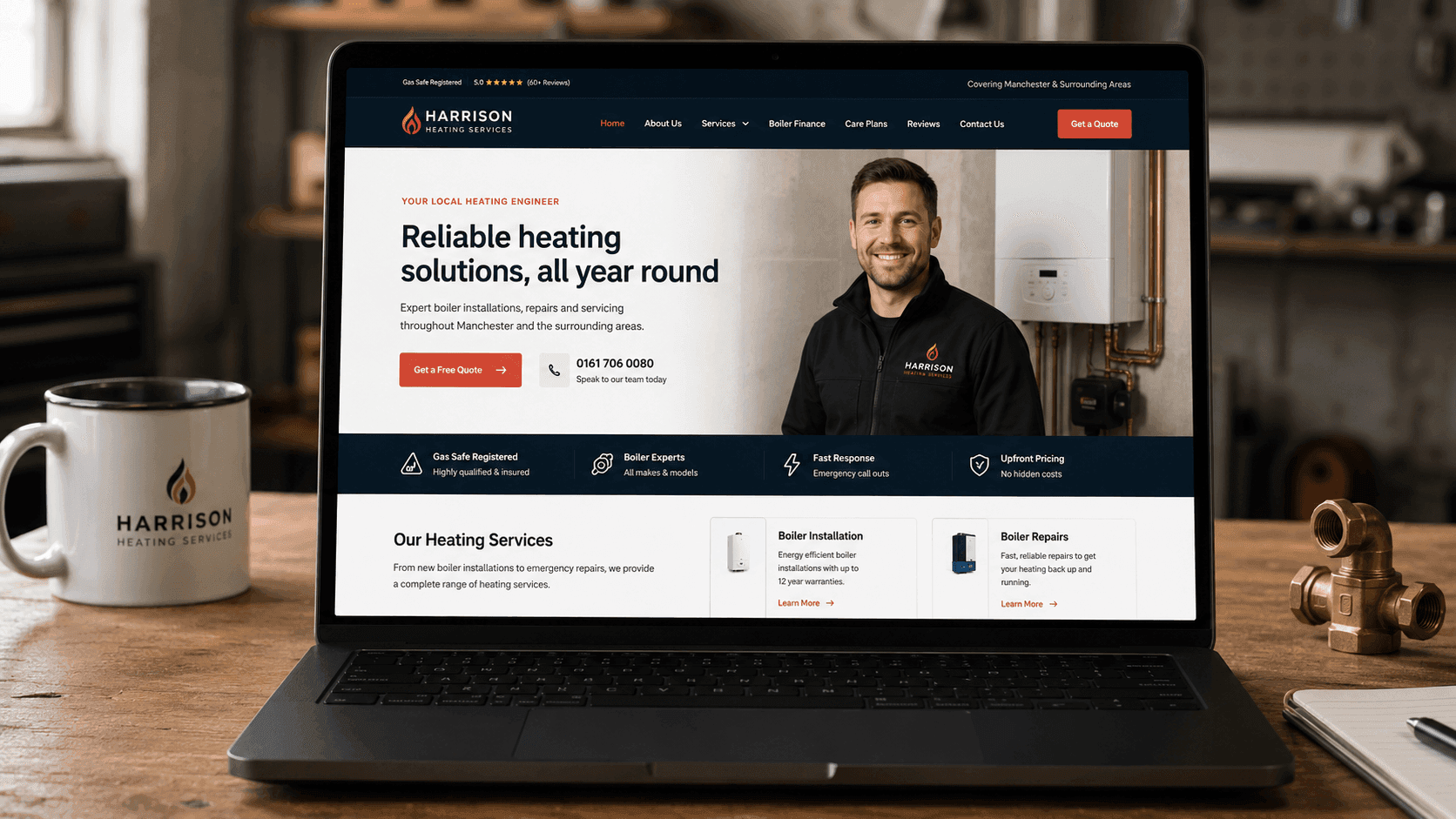
The answer in one line: every heating engineer needs Home, About, Services index, five service pages, Coverage Area and Contact. That's 10 pages, each one earning a separate Google entry and a separate reason for a customer to land on your site.
Most heating engineer websites look the same. Three pages: Home, About and Contact. The home page lists what you do in a paragraph, the about page has a stock photo of a Gas Safe logo and the contact page is a phone number on its own.
It's not enough.
When a homeowner searches "boiler installation Bristol" they don't want a homepage that mentions installation in passing. They want a page that is about boiler installation in Bristol. Same for "powerflush quote Manchester" or "landlord gas safety check Leeds". Google ranks pages, not websites. If you've got one page mentioning seven services, you'll lose to the engineer down the road who has seven pages each about one service.
Why do most heating engineer websites only have 3 pages?
Three reasons.
The website builder default. Wix, Squarespace and most cheap templates ship with a 3-page starter. The builder doesn't push you to expand. You hit publish with what they gave you.
Time. Writing one page is hard. Writing ten feels like a job in itself. Most engineers stop after three.
Old advice. The Home / About / Contact formula was right in 2009. It's wrong in 2026. Google has got better at extracting topic specific content and customer search has gone hyper-specific.
The result: a site that looks fine, sits at page 5 on Google and brings in one enquiry a month. Whoever has the proper 10-page setup is taking the rest.
What are the 10 pages every heating engineer website needs?
The full list:
- Home: the door
- About: the trust page
- Services index: the menu
- Service page 1: one of your top 5 services
- Service page 2: same
- Service page 3: same
- Service page 4: same
- Service page 5: same
- Coverage Area: the geographic page
- Contact: the booking page
Each one ranks for a different search. Each one earns a separate enquiry. Let's walk through them.
Why does the Home page need to be more than a sign-up sheet?
The home page is the first thing most visitors see, but it isn't where most of your Google traffic lands. Search engines send people to the most specific page. If someone searches "Worcester boiler installation Cardiff", Google sends them to your boiler installation service page, not your home page.
So the home page has a different job. It needs to:
- Tell a visitor in three seconds what you do, where you cover and what makes you different
- Show your accreditations clearly (Gas Safe number, Vaillant Approved or Worcester Accredited if relevant)
- Link out to your services index and coverage area
- Carry a short marketing video if you've got one
- End with a clear way to get a quote
What it doesn't need: a 2,000-word manifesto about your love of plumbing.
The marketing video matters here. A 25 to 60 second branded video built from your business details and services is the difference between a site that says you do good work and a site that shows it. It's also one of the few ways to look more credible than the local agency-built sites in your area, because most engineers don't have one. The £295 Syntorak heating engineer website offer bakes the video in. Other builders charge £200 to £500 extra for it, if they offer it at all.
Why do you need a separate page for each of your top 5 services?
This is the part most engineers skip. They list services on the home page in a paragraph and call it done. That paragraph might mention seven services in one breath: boiler installation, boiler repair, boiler service, powerflushing, landlord gas safety checks, central heating installation and smart thermostat fitting.
In Google's eyes, that's a page about everything, which means it's a page about nothing.
Compare to a competitor with separate pages:
- /boiler-installation/
- /boiler-repair/
- /boiler-service/
- /powerflushing/
- /landlord-gas-safety/
Each page is 600 to 800 words about that one service: what it costs, what it involves, what you provide, who you cover and what to expect. Google indexes each page separately and ranks each one for its own search. Five separate doors into your site.
The trick is picking the right five. If you do twelve services, pick the top five by revenue or by search demand in your area. The other seven get a brief paragraph each on the services index page (we'll get to that in a minute).
Why is the Coverage Area page the most overlooked?
Customers search by town. "Heating engineer Bath", "boiler repair Solihull", "powerflush Edinburgh". If you cover ten towns and your site only mentions one (we're based in Bath), you lose nine searches.
The Coverage Area page lists every town you cover, with a short paragraph on each. Two purposes:
- It tells Google you serve those towns.
- It tells the customer searching "boiler installation [their town]" that they're in the right place.
Don't fake it. Don't list thirty towns you'd never drive to. List the ones you actually work in. Be specific. "Bath, Bristol, Keynsham, Saltford, Chew Magna, Hanham, Yatton, Clevedon." Specificity beats coverage every time.
If you cover a single town, the page becomes "Our service area in [town]" with neighbourhood detail. It still earns its place.
Why does the About page matter more than you think?
Homeowners book engineers they trust. The About page is where that trust gets earned. Three things to include:
Who you are. Real name, real photo. Not a stock image of a wrench. The customer wants to know who's coming round.
How long you've been doing this. Number of years, what got you into it. Honesty over flannel. If you started last year, say so. New engineers earn trust through enthusiasm, not invented experience.
Your accreditations. Gas Safe register number (link to the register lookup), Vaillant Approved or Worcester Accredited if relevant, MCS if you do heat pumps. Family-run, second generation, local since 1998: include the lines that are actually true.
Do you need a separate Accreditations or Gas Safe page?
Some engineers do this. It isn't on the 10-page spec because it splits the trust signal across two pages instead of one. Better: keep accreditations on the About page and on the home page hero, link to the Gas Safe register check from both. Two pages mentioning your number, in the places visitors actually look, beats a dedicated page nobody visits.
Why a Services Index page (and not just a dropdown)?
The Services Index is a menu page that links to every service page you have. Three purposes:
Internal linking. Every service page links back to the index, which links to every other service page. That's a signal to Google that this site is comprehensively about heating services.
Customer browsing. Some visitors want to see the full list before clicking through.
Catch-all for services that don't earn a full page. If you do twelve services and only five get full pages, the remaining seven get a one-paragraph mention here.
The dropdown in the top navigation isn't a substitute. Google reads the page in the body of the site, not the menu hover-states. You need a dedicated URL.
Why is the Contact page worth a proper page (and not a footer email)?
Plenty of sites bury contact details in the footer. Big mistake. The Contact page is the page someone lands on when they've decided to enquire. Make it easy.
What it should have:
- A working contact form, with replies routed to your inbox
- Phone number, clickable on mobile so a tap dials
- WhatsApp number (huge for trade customers)
- Opening hours
- A list of postcodes you cover
Don't ask for ten fields. Name, email, phone, message. Anything more and people bail.
How does a 10-page site compare to a 3-page site?
| Thing | 3-page site | 10-page site |
|---|---|---|
| Pages | Home, About, Contact | Home, About, 5 services, services index, coverage, contact |
| Google entry points | 3 | 10 |
| Searches it can rank for | Business name only | Service searches, town searches, business name |
| Trust signals | One About page mention | Home, About and every service page |
| Internal links | 6 to 9 total | 30+ total |
| Time to build solo | 3 to 5 evenings | 3 to 5 weekends |
| Typical enquiries per month | 1 to 3 | 5 to 15 |
The numbers in the last row aren't guaranteed. They're what we see across the heating engineer sites we've built when the spec is right and the local search market is normal.
What does it cost to do this properly?
Three options.
DIY in Wix or Squarespace. Free to £20 a month, plus hours of evenings. The build itself takes most engineers 2 to 3 weekends. You'll hit walls when you need a contact form that actually works, or proper SEO, or schema.org markup that Google reads.
Local agency. £800 to £2,500 for the build, £30 to £80 a month thereafter. Quality varies wildly. Some are good. Some give you a 3-page site that looks fine and ranks nowhere.
Syntorak £295. One-off £295, £75 a year from year two. All 10 pages, branded marketing video, your own .co.uk, hosting, SSL, contact form, SEO done properly. Live in days not weeks. See what's included or look at three live examples before you decide.
The point isn't buy from us. The point is 10 pages well done is the right target, not 3. Whoever does it first in your area wins the search results.
If your current site is 3 pages, the question isn't whether you need 10. It's whether you'd rather take the next move or watch a competitor take it.
Pick five services. List your real coverage area. Write a proper About page with your photo. Build the services index. Each page earns its place because each page earns its own enquiry.
If you'd rather we did it for you, the £295 offer covers all 10 pages and a marketing video, live in days. See it before you pay. No deposit.
FAQ
Common questions about this
Do I really need 10 pages, can't I just have 3?
What if I only do 2 or 3 services, do I still need 5 service pages?
Won't Google penalise me for thin pages if I have 10?
How long does it take to write the content for 10 pages?
Can I add more pages later?
Related
More for heating engineers

How long does Google take to index a new heating engineer website?
Bought a website weeks ago and still nothing on Google? That's normal in week 1, less normal by week 4. Here's what indexing actually means, how long it really takes and the four things that speed it up.

Should you have a marketing video on your heating engineer website?
Most heating engineer websites don't have a marketing video. Here's the case for adding one, what should and shouldn't go in it and when it isn't worth the effort.
The £150 cheap-builder website trap for tradespeople
There's a tier of websites pitched at tradespeople at £150 to £250 a build. Most are generic WordPress installs with no SEO, no proper hosting and a builder who disappears within 3 months. Here's how to spot the trap before you pay and what to do if you've already paid.