

How to get your first 10 Google reviews as a heating engineer
Most heating engineers have 2 Google reviews and don't know how to ask for more. The first 10 are the hardest. Here's the script and the timing that actually work.
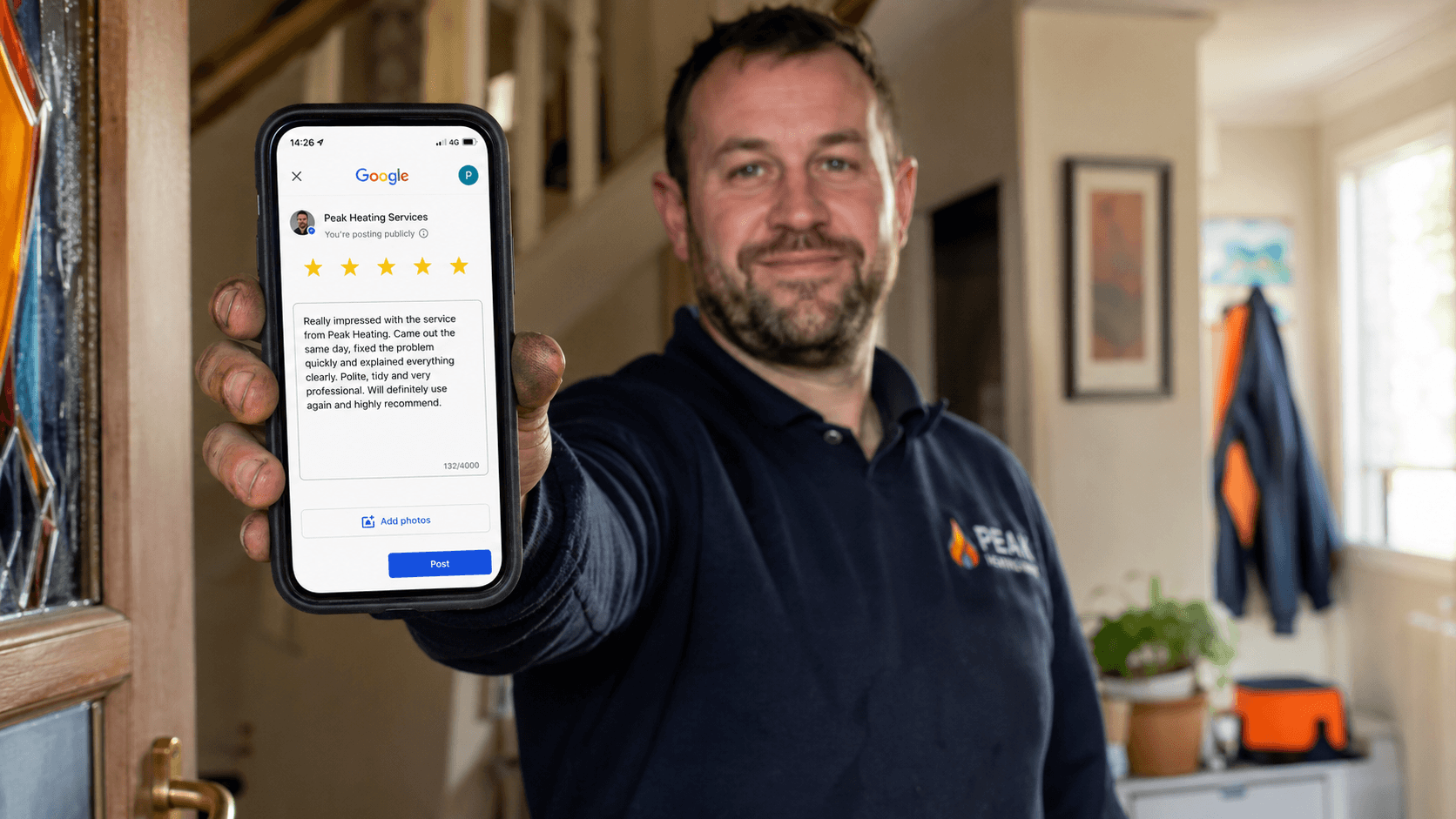
The answer in one line: ask at the end of the job while the boiler is firing and the customer is visibly happy, send a one-tap WhatsApp review link an hour later if they nod, do that with every customer for a month and you'll have your first 10 reviews in 6 to 8 weeks.
Most heating engineers we work with have between 2 and 8 Google reviews after 5+ years in business. The same engineers do 200 to 400 jobs a year. The maths is brutal: for every 100 happy customers, around 1 leaves a review without being asked. That's the gap this post closes.
Reviews are the single highest ROI marketing a small heating business has. Every customer search on Google shows your review count and average rating next to your name. The customer scanning their options doesn't read your About page or click through to your services. They see "4.9 stars · 38 reviews" or "4.7 stars · 4 reviews" and decide in 2 seconds which engineer to call.
This post is about how to close that gap. Plain English, exact wording, no fluff.
Why are Google reviews the highest-ROI marketing a heating engineer can do?
Three reasons.
Visibility. Google reviews show in three places no other marketing reaches: the Google Search result for your business name, the local map pack (the three businesses with the little A B C pins) and inside Google Maps when someone searches "heating engineer near me". Facebook reviews show in none of those. Trustpilot shows in none of those.
Trust at zero cost. A new customer doesn't know you. They do know the 27 people who already rated you. Each star and each sentence shifts the odds in your favour without you having to spend a penny on ads.
Local SEO impact. Google uses review count and average rating as a ranking factor in the local map pack. Three things move you up: number of reviews, average rating and recency. A profile with 4.7 stars and 30 reviews from the last 12 months beats a profile with 4.9 stars and 80 reviews where the most recent one is 4 years old.
You spend nothing. The customer spends 90 seconds. The return compounds for years.
Why do the first 10 reviews matter more than the next 100?
Two reasons.
The social proof threshold. In our experience most homeowners hesitate to book a tradesperson with fewer than 5 Google reviews. Under 5 reads as "new or part-time, might not be reliable". Over 10 reads as "established business, plenty of others trusted them". Moving from 4 to 12 reviews carries you across that threshold. Moving from 50 to 58 doesn't.
Star average stability. With 3 reviews, a single 1-star takes you from 5.0 down to 4.0. With 30 reviews, the same 1-star moves you from 5.0 down to 4.87. Volume protects you. Past 10, a single grumpy customer can't tank your average.
The implication: the first 10 reviews are the highest-leverage marketing project a new heating engineer has. After that, the system is on autopilot if you keep asking.
When should you ask for a Google review?
The single best moment is at the end of the job, while the boiler is firing, the radiators are warming up and the customer is visibly pleased it's working.
The next best moments, in order:
- End of job, on site, work clearly successful (highest conversion rate)
- One hour after leaving, via WhatsApp (good follow-up)
- The morning after the job (still warm)
- Three days later (conversion roughly halves)
- A week later (forget it, most won't bother)
The half-life on customer goodwill is short. The work goes from "magic, you fixed it" to "well, that's what we paid for" within a few days. Catch them in the first 24 hours or your conversion rate falls off a cliff.
How should you actually ask?
In person, at end of job, the script that works:
"Quick favour if you've got a sec. Most of my work comes through Google these days, and a one-line review on there makes a big difference for a small business like mine. I'll send you the link on WhatsApp now. It's a one-tap thing, takes under a minute. Doesn't have to be long, just whatever you'd want to know yourself if you were looking for an engineer."
That's it. Five things make this work.
The favour framing. "Quick favour" beats "would you mind", which beats "could you write a review for me". Lowest possible ask, lowest possible commitment.
The reason. "Most of my work comes through Google" tells them why it matters to you. Customers want to help a local business they liked.
The mechanical promise. "One-tap thing, takes under a minute." Removes the imagined hassle of writing an essay.
The length permission. "Doesn't have to be long." Most customers don't write because they think a review has to be a paragraph. Tell them one line is enough.
The angle. "Whatever you'd want to know yourself." Gives them an angle to write from. Reviews written this way also convert future readers better.
Send the WhatsApp link before you leave their driveway. Don't wait until you're back at the office.
How do you set up a one-tap Google review link?
Find your Google Business Profile review link once, save it, and reuse it forever.
The fastest route:
- Search your business name on Google when signed in to the email tied to your profile
- On the right-hand panel for your business, tap "Ask for reviews" or "Get more reviews"
- Google generates a short link, something like
g.page/r/CXX... - Copy it. Save it as a phone shortcut, a WhatsApp quick-reply or a pinned note
That one link, tapped by the customer, takes them straight to the 5-star tap-and-leave screen on Google. No "find the business on Google, click reviews, write a review" hunt. Conversion lifts substantially on the one-tap link alone, often from low single-digit percentages to a meaningful share of the customers you ask.
A few minutes of setup, hundreds of reviews of payoff over the life of the business.
What if they say yes but never leave a review?
Most won't. That's expected.
Send one polite follow-up 48 hours later: "Hi [name], hope the boiler's still behaving. If you've got a sec for that Google review, here's the link again [link]. Thanks again for the work." That's it. One follow-up. Don't pester.
If they don't respond, move on. Some customers will never leave a review even though they meant to. Asking three times poisons the relationship and never lifts the conversion rate.
Volume beats conversion rate. If you ask 20 customers and 6 leave reviews, that's 30% conversion. The way to get more reviews isn't a 50% conversion rate. It's asking 40 customers next month instead of 20.
What do you do about a bad review?
You'll get one. Every heating engineer in business 3+ years has at least one 1-star review. Some are fair, some are mad, some are mistaken identity. The reply matters more than the review itself.
Three rules for the reply.
Reply within 24 hours. Speed signals you care. Two-week-old unanswered 1-stars look bad.
Stay polite, stay factual. Future customers reading your replies care about how you handled it, not what happened. A calm professional reply ("Hi [name], I'm sorry your experience didn't meet expectations. I've sent you a message offline to see if we can resolve this. Happy to chat further") reads better than a defensive one ("Actually that isn't what happened, the boiler was already broken when I arrived").
Never name and shame. Don't share customer details, addresses or specifics in a public reply. Reply at a level any future reader can stomach.
If a review breaks Google's policies (fake review, mistaken identity, abusive language), report it via the "Flag as inappropriate" link. Google removes maybe 30% of flagged reviews. Worth doing for the clearly broken ones.
How should you reply to good reviews?
Every single one. One short sentence is plenty.
Good template:
"Thanks [first name], glad it's all working again. Any issues, give us a shout."
Why every reply matters.
Future customers read replies. A profile with replies on every review reads as actively run and personal. A profile with reviews and no replies reads as abandoned.
Google notices engagement. Active profile management is a (minor) ranking signal.
Practice for the inevitable. When the negative review lands one day, you're already in the habit of replying within 24 hours. The negative reply doesn't stand out as unusually defensive because every reply you write is short and professional.
Keep the replies tight. Don't write paragraphs. First name, one sentence, sign-off optional.
The 5 most common Google review mistakes heating engineers make
The patterns we see most often, in order of how much they cost.
| Mistake | Why it costs you | What to do instead |
|---|---|---|
| Not asking at all | Single biggest loss. 99% of happy customers won't leave one unprompted. | Ask every customer, in person, end of job. |
| Asking three days later by email | Conversion drops below 10%. Customer has moved on. | Ask on site or via WhatsApp within the hour. |
| Sending the full Google URL | Customer hits a Google login wall and gives up. | Use the short g.page review link. |
| Offering discounts for reviews | Reviews get flagged and removed. Profile gets penalised. | Don't. Just ask politely. |
| Ignoring the bad ones | Unanswered negatives sit at the top of your profile. | Reply within 24 hours, calm and factual. |
Fix all five and you'll outperform 90% of local heating engineers on review count and quality inside 12 months.
Where to start: a 6-week plan
Week 1:
- Set up your one-tap g.page review link, save it as a WhatsApp shortcut
- Write your end-of-job script on a card, keep it in the van
Week 2 to 5:
- Ask every customer, every job, every day
- Send the WhatsApp link before leaving their driveway
- One follow-up 48 hours later, then move on
Week 6:
- Count reviews. Most engineers who do this hit 8 to 12 reviews in 6 weeks.
- Reply to every one, even the 5-star ones. One sentence each.
Once you're past 10 you've crossed the threshold. After that the system runs itself as long as you keep asking.
The website you point those reviews at matters too. If a customer reads "4.9 stars, 38 reviews", clicks through to your Google Business Profile, then to your site, and the site is one page on a free Wix template, the trust you just built melts. The pages on your site should be earning that trust as hard as the reviews are.
If you want a site that does that work, the £295 Syntorak heating engineer website ships with 10 properly written pages, a branded marketing video and your own .co.uk, live in days. Read what the 10 pages actually are or why the DIY Wix and GoDaddy options usually cost more over 5 years.
Reviews are the cheapest marketing you'll ever do. Asking is the hardest part. After 20 customers it stops feeling weird.
FAQ
Common questions about this
Can I offer a discount or a freebie in exchange for a review?
What if I get a bad review I don't think is fair?
Should I be asking on Facebook or Trustpilot instead?
How fast can I realistically go from 0 to 10 reviews?
Should I reply to every review, even the 5-star ones?
Related
More for heating engineers
What to put on the About page of a heating engineer website
Most heating engineer About pages are a stock photo and a paragraph that says 'pride ourselves on quality'. Here's what to put on yours that actually earns trust, plus a template that works for a single-engineer business.
The £150 cheap-builder website trap for tradespeople
There's a tier of websites pitched at tradespeople at £150 to £250 a build. Most are generic WordPress installs with no SEO, no proper hosting and a builder who disappears within 3 months. Here's how to spot the trap before you pay and what to do if you've already paid.

How long does Google take to index a new heating engineer website?
Bought a website weeks ago and still nothing on Google? That's normal in week 1, less normal by week 4. Here's what indexing actually means, how long it really takes and the four things that speed it up.